


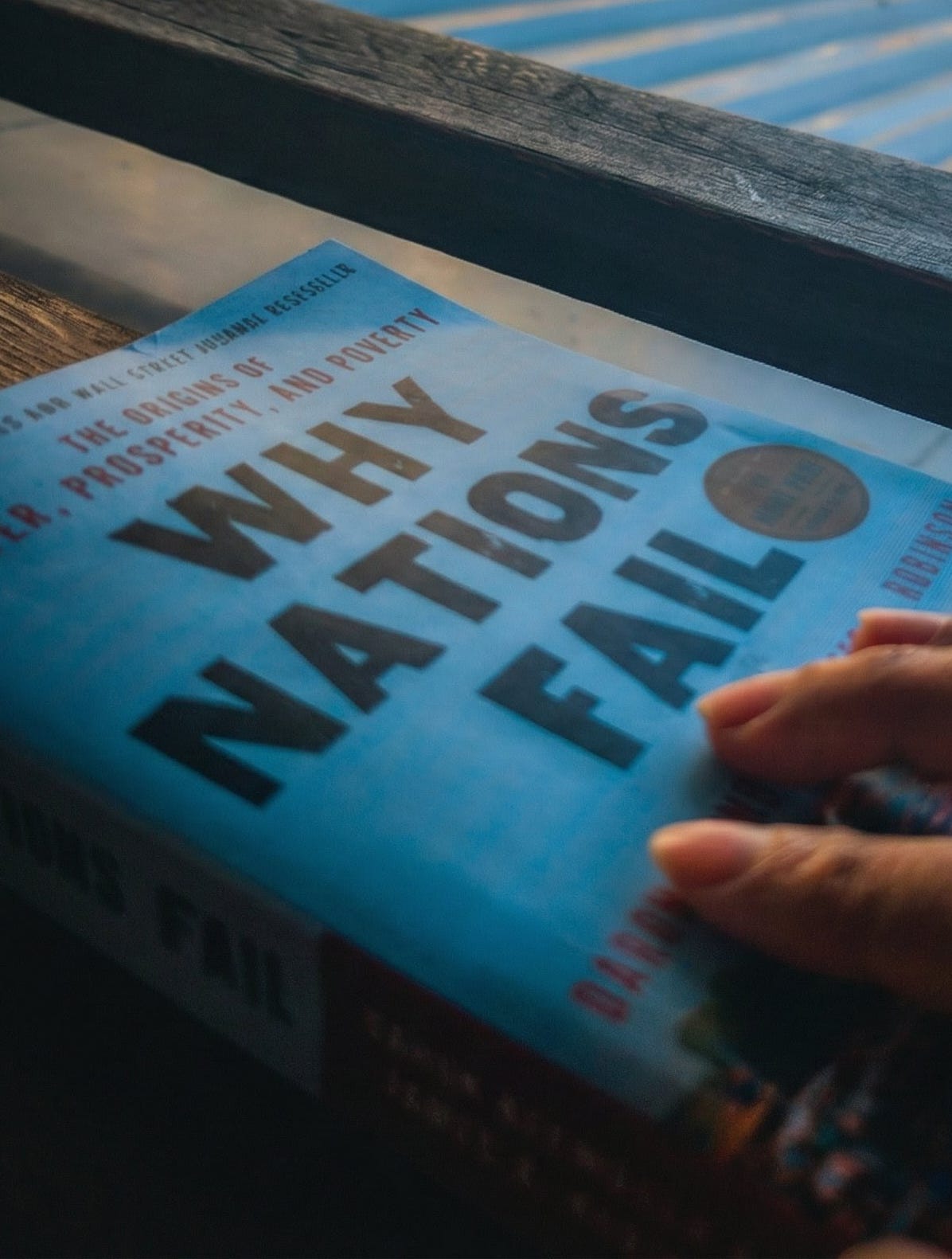
I eventually finished reading ‘Why Nations Fail’, by James A. Robinson and Daron Acemoglu.
It covers thousands of years of history, is dense, and boldly asserts that geography is irrelevant. Culture is irrelevant. The only thing separating the rich from the poor is institutions.
As I turned the pages, reading about the colonization of South America, the Glorious Revolution in England, and the intricacies of Botswana’s diamond trade, I couldn’t help but constantly mentally CTRL+F for “Maldives.”
Although the Maldives isn’t specifically examined in the book,the framework is so appropriate for our island setting that it almost feels awkward. From the perspective of a Maldivian examining our economy, history, tourism, and precarious democracy, these are my thoughts on the book.
The Main Concept: Inclusive vs. Extractive
The writers’ thesis is straightforward. When a country has inclusive institutions, laws and procedures that enable a large number of people to participate, innovate, and earn money it succeeds. They fail when they have Extractive Institutions. They are the systems designed to take wealth from the many and funnel it to a small elite.
As Acemoglu and Robinson write:
Nations fail today because their extractive economic institutions do not create the incentives needed for people to save, invest, and innovate. Extractive political institutions support these economic institutions by cementing the power of those who benefit from the extraction.
The “Geography Hypothesis”; the notion that we should be impoverished because we are small, remote islands with no resources—was the prevailing narrative about the Maldives for a very long time. Or, conversely, that we are a “paradise,” so we should be rich.
Why Nations Fail argues that resources are irrelevant if the “rules of the game” are rigged.
The Resort Tycoon vs. The Guesthouse Owner
This is where it hits home.
For decades, Maldivian tourism was the textbook definition of an Extractive Institution. “One island, one resort” was our policy. This sounds fantastic for privacy, but from an economic standpoint, it established a system in which a small number of tycoons, often with strong ties to political power, controlled the main economic engine.
The wealth was generated in the atolls, but it was extracted and sent straight to Male’ (or offshore bank accounts). The islanders who live next to the opulent resort? They were often barred from even visiting. They didn’t have property rights over their own lagoon. They were spectators in their own economy.
The “Guesthouse Revolution” then began, roughly in 2009 or 2010.
This was a move toward inclusivity, according to Acemoglu and Robinson.
Families in Maafushi, Thoddoo, or Dhigurah were suddenly able to take part in the market. You didn’t need millions of dollars and a government lease to start a business; you just needed a spare room and some hustle.
The outcome? You can see it physically. Cafes, dive centers, and multi-story buildings have suddenly appeared on islands that were drowsy and reliant on Male. That is the power of inclusive economic rights.
The “Iron Law of Oligarchy”
The book does, however, also issue a warning regarding the “Iron Law of Oligarchy.” This is the depressing tendency for new leaders to overthrow old tyrants, only to take over the exact same extractive machinery and use it for themselves.
History is not destiny... inclusive institutions are not the only possible outcome. In fact, they are the exception. The norm is extractive institutions.”
This hurts a little when you consider our political history since 2008.
We’ve had several presidential and party changes. But have we changed the institutions?
The judiciary is still frequently viewed as a political instrument.
State-Owned Enterprises (SOEs) are still used to hand out jobs in exchange for loyalty (patronage politics).
Male’s concentration of power creates a bottleneck where you need to “know someone” in order to complete tasks.
The book makes the case that if we don’t break this cycle, that is, if we don’t create institutions that are more powerful than the individuals in positions of authority, we will simply keep switching out elites while the system continues to be extractive.
Creative Destruction
One of my favorite concepts in the book is Creative Destruction. This is the idea that for an economy to grow, old ways of doing things must be allowed to die so new ones can rise. The problem is, elites hate creative destruction. It threatens their monopolies.
Creative destruction creates losers as well as winners in the political arena as well as in the economic marketplace... Fear of creative destruction is the main reason why there was no sustained increase in living standards between the Neolithic and Industrial revolutions.
We witness this tension all the time in the Maldives. We see it when taxi centres fought against introducing ride-hailing apps years ago when they were first introduced. We see it when big resort operators lobby against guesthouses, claiming they “ruin the brand”. In reality they just hate the competition.
A successful nation allows the new to replace the old. The old guard is shielded at the expense of everyone else in a failing country.
The Verdict
Why Nations Fail is a bit repetitive, and it perhaps ignores how international geopolitics (like China vs. India) forces small nations like ours into tough spots regardless of our internal institutions.
But as a framework for understanding the Maldives? It’s essential.
It made me realise that our development isn’t about building a bigger bridge or reclaiming more land. These are merely signs of development. The question of whether a young person on an island has the same political voice, economic opportunities, and legal protections as a landlord in Male’ is what constitutes real development.
We are successful if we can create institutions that safeguard that individual. The book’s title pretty much sums up what happens if we create systems that only shield the wealthy and powerful.
Rating: 4.5/5 Even if you just skim the historical chapters to get to the theory, it’s still highly recommended.