


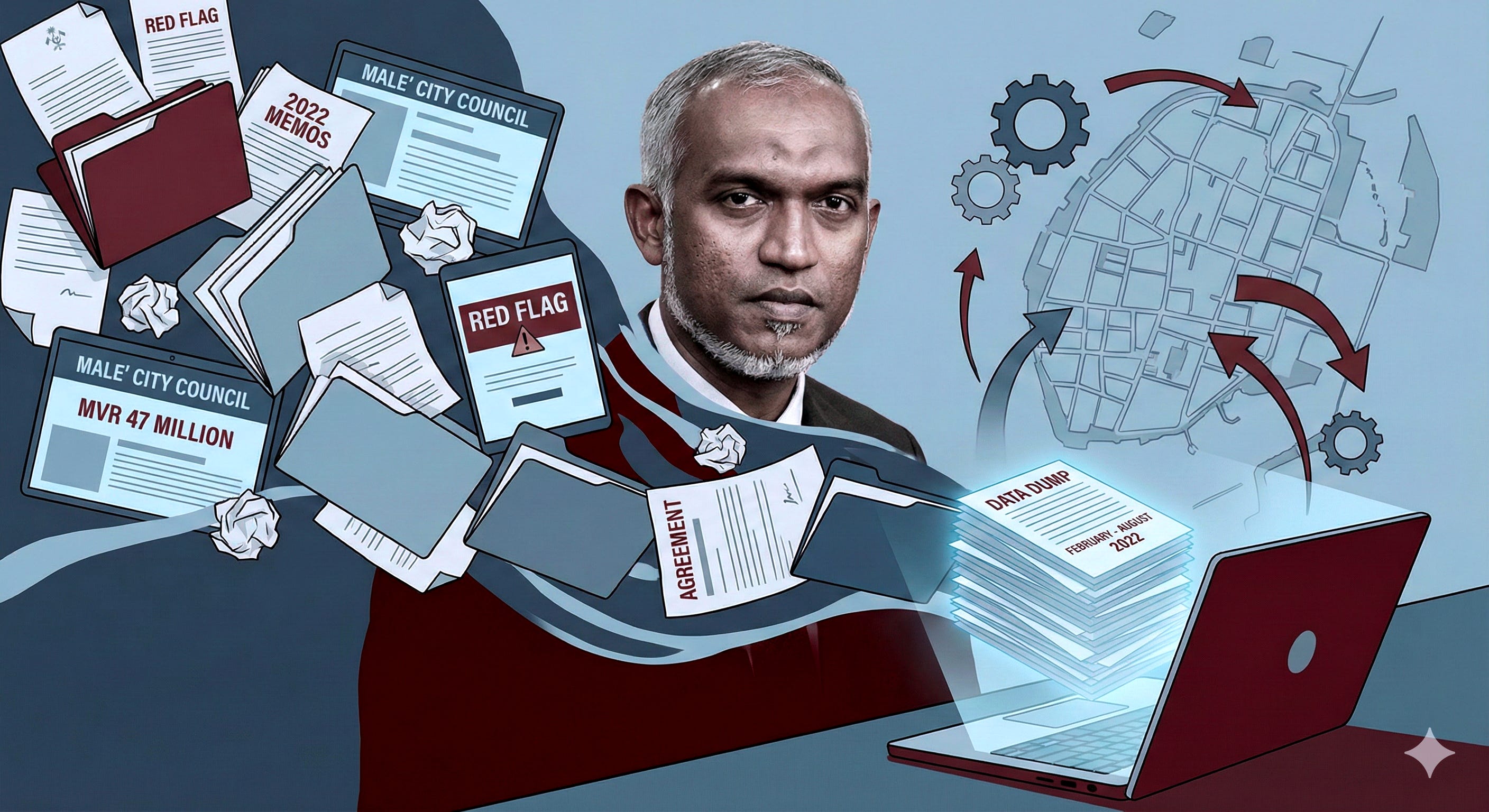
For months, a folder of 355 documents has been sitting on my laptop. They date back to a specific six-month window in 2022—February to August—when President Dr. Mohamed Muizzu was the Mayor of Malé. Today, I thought I would release them all. So I am doing it. Here it is:
In investigative journalism, you often look for the “smoking gun.” But sometimes, corruption isn’t a single explosion; it’s a slow, steady leak.It is a pattern of small, bureaucratic maneuvers that, when stitched together, reveal a machine built for purposes other than public service.
For quite some time, I have been analyzing a cache of internal agreements, memos, and bid evaluation reports from the Malé City Council, dated specifically between February 13 and August 14, 2022.
These documents cover a total expenditure of MVR 47,223,029.00.
After cross-referencing contracts, comparing vendor awards,and scrutinizing the timing of payments, my analysis suggests that approximately MVR 14,093,015.00, nearly 30% of the total, is tied to transactions raising serious red flags.
These documents paint a picture of how the City Council may have been maneuvered to serve political ambitions, funded by the public purse.
The Mechanics of the Operation
The memos suggest a centralized operation where procedural safeguards were bypassed with alarming regularity. Orders coming directly from the mayor’s bureau. Key figures, including the former Secretary General of the Council—now the Managing Director of WAMCO, Mujtaba Jaleel—appear frequently in the approval chains of these questionable decisions.
Here are my observations on how the “Data Dump” reveals how the money moved on.
1. Contract Splitting
The most common red flag in public procurement is “splitting”, breaking a large contract into smaller chunks to keep them below the financial threshold that requires a public tender or stricter board approval.
One example is that the documents show this was done repeatedly with catering.
The Athamana Event: A single event saw its catering split into multiple contracts. Gourmet Fine Dine Super Food was awarded MVR 816,200.00 (Agr 293) and then a second contract for MVR 230,200.00 (Agr 294) for the same distribution event1.
Lunch vs. Dinner: For the same event on July 6th and 7th, the Council issued separate contracts to Saifodhu. One agreement was for lunch (MVR 139,920) and another for dinner (MVR 349,800)2.
By fragmenting these expenses, millions flowed to vendors without the scrutiny a single MVR 1 million+ tender would invite.
2. Price Paradox: The “Sound Squad” Case
Perhaps the most glaring anomaly involves Sound Squad Pvt Ltd.
On August 24, 2022, the company was awarded MVR 700,000.00 for sound and lighting for the Madhaha and Quran Mubaaraathu (Agr 316)3.
Just one week later, on August 31, 2022, a second agreement (Agr 322) was signed with the same company for the same event—but this time the price was MVR 318,000.00.
Why did the price of the same service drop by MVR 382,000 in seven days? Or conversely, why was the first contract inflated by over 100%? The documents offer no justification for this discrepancy.
3. The “Jack of All Trades” Vendors
Preferential treatment appears evident in the Council’s reliance on specific vendors for wildly different services.
Tonic Live Studio, typically an AV/Events company, was handed a MVR 773,800.00 contract for “WDC Live Setup” (Agr 265).
Yet, the same company was also awarded a MVR 450,000.00 contract to supply 20 computer systems (Agr 287).
When a music studio is winning IT hardware supply contracts, it suggests the vendor is being chosen for who they are, not what they can arguably do best.
4. The Consultant Army
Between July and August 2022,the Council locked in a cluster of long-term consultants.
Five separate individuals were given 1-2 year contract extensions in quick succession.
Their monthly rates ranged from MVR 25,000 to MVR 35,000, totalling millions in committed future spending.
These “consultants”—covering areas from urban planning to management to copywriting—were locked into the payroll just as the mayor’s political profile was expanding.
These are few examples.
The Data Dump: Your Turn
The total monetary value of the red flags I have identified is MVR 14 million, but I believe this is just the tip of the iceberg. There are more.
I am releasing the full dataset, 355 documents, including bid evaluation reports, signed agreements, and internal memos.
I want you to look through them. I want other journalists, auditors, and the public to do the math. And this is why the Auditor General’s Office should audit the City Council thoroughly.