


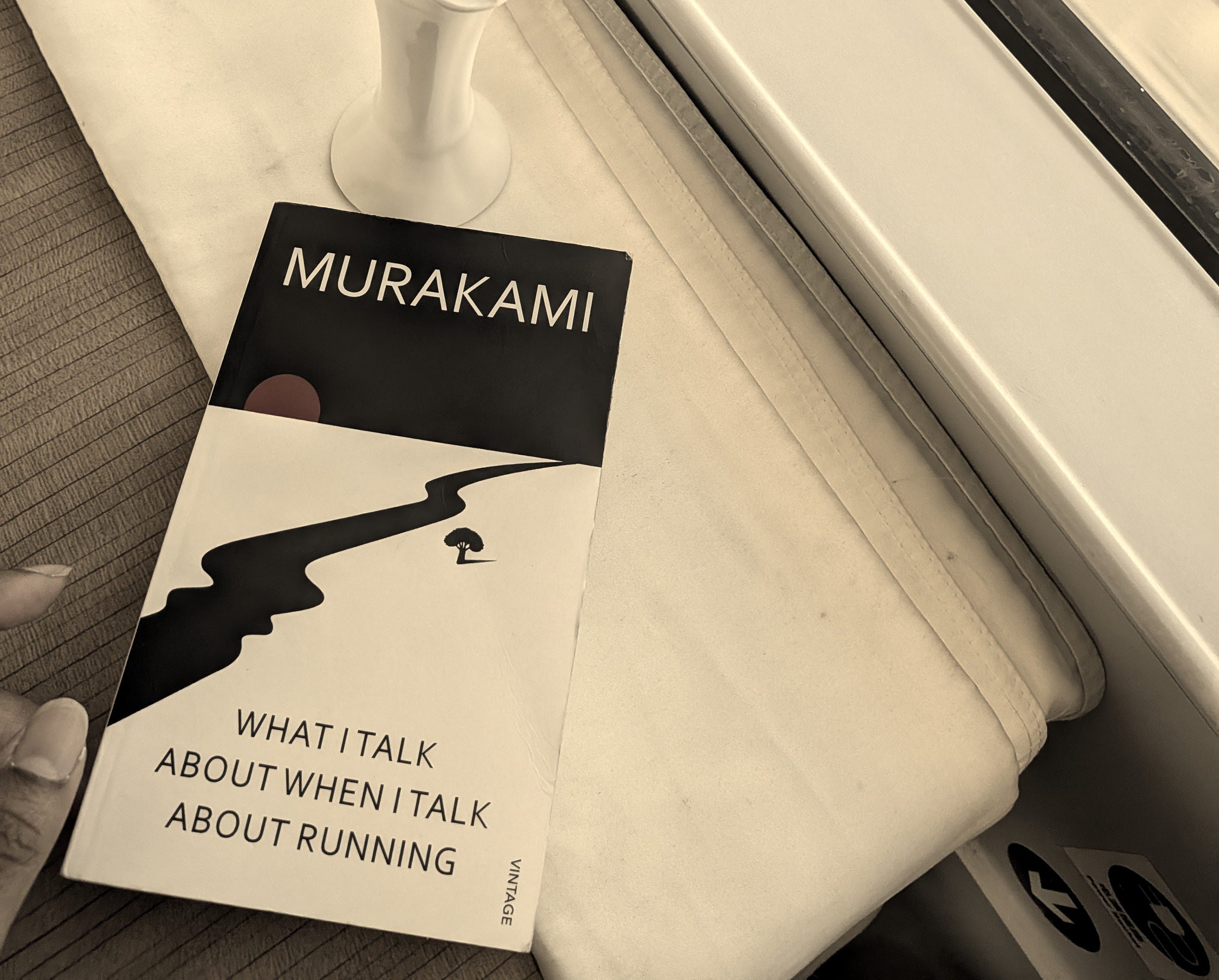
The scenery outside my window was a blur as the train sped south from Beijing to Nantong in Jiangsu Province. Inside, the rhythmic hum of the tracks was like a metronome, steady and relentless, matching the strike of a runner’s foot on the pavement. I turned the last page of Haruki Murakami’s What I Talk About When I Talk About Running to this relentless soundtrack. My dear friend Mohamed Hamdhoon gifted me this book, and I am grateful to him; it came to me at just the right time.
If you buy this book looking for a training manual you will be disappointed. If you are expecting a typical literary memoir, you will be surprised. What Murakami has written, in fact, is a deep meditation on the architecture of a life well-lived. And the blueprint, it turns out, is terrifyingly simple: consistency.
The Unglamorous Art of Showing Up
We live in a culture obsessed with “hacks,” with shortcuts and divine inspiration in a flash. He takes it all away, Murakami. He sees both his running and his writing as manual labor, not mystical calling. You open your eyes. You put your shoes on. You hit the desk or you hit the road. You do it when you want to, and, more importantly, you do it when you don’t.
“Exerting yourself to the fullest within your individual limits: that’s the essence of running, and a metaphor for life—and for me, for writing as well as whole.”
This philosophy hits with a physical weight these days as I lace up my own shoes, chipping away at the mileage it will take to finally cross a marathon finish line. The long runs are seldom glamorous. They are often dull, lonely and tiring. But Murakami captures that profound, quiet victory of just not quitting.
He does not see the repetitive daily grind as a punishment but as a privilege. In one of the book’s more arresting passages, one that buzzed in my head as the train slid into Jiangsu, he gets to the very heart of why we drive ourselves:
“Runners run not to live longer but to live life to the fullest.”
Pain as a Compass
Murakami is not unaware of the mental and physical price of dedicating yourself to one pursuit. But he alters the relationship we have with discomfort. Whether it’s hitting the infamous “wall” at mile 20, or staring at a blank page when the words refuse to come, the friction is part of the point.
“Pain is inevitable. Suffering is optional. Say you’re running and you think, ‘Man, this hurts, I can’t take it anymore. The ‘hurt’ part is an unavoidable reality, but whether or not you can stand anymore is up to the runner himself.”
This is the ultimate lesson of the book, going far beyond the bounds of marathon training. If we want to be consistent in our doings – be it our careers, our art, or our relationships – we have to accept that the “hurt” is part of the contract. The pain only starts when we fight it. When we admit that, it’s just data. It is the pavement on which we run.
Building a Life One Step at a Time
The train came to a halt at its last stop and I closed the book, now somewhat clearer about things. What Murakami is not saying is that everyone should be an ultramarathoner or a prolific novelist. He’s telling us that our lives are built up in the aggregate.
“I’m no great runner, by any means. I’m at an ordinary – or perhaps more like mediocre – level. But that’s not the point. The point is whether or not I improved over yesterday. In long-distance running the only opponent you have to beat is yourself, the way you used to be.”
What I Talk About When I Talk About Running is a reminder that there are no shortcuts to a meaningful life. You just have to pick a direction, establish your rhythm, and keep putting one foot in front of the other.
Tomorrow morning, I’ll wake up and hit the road again. Not to live forever, but to live today.